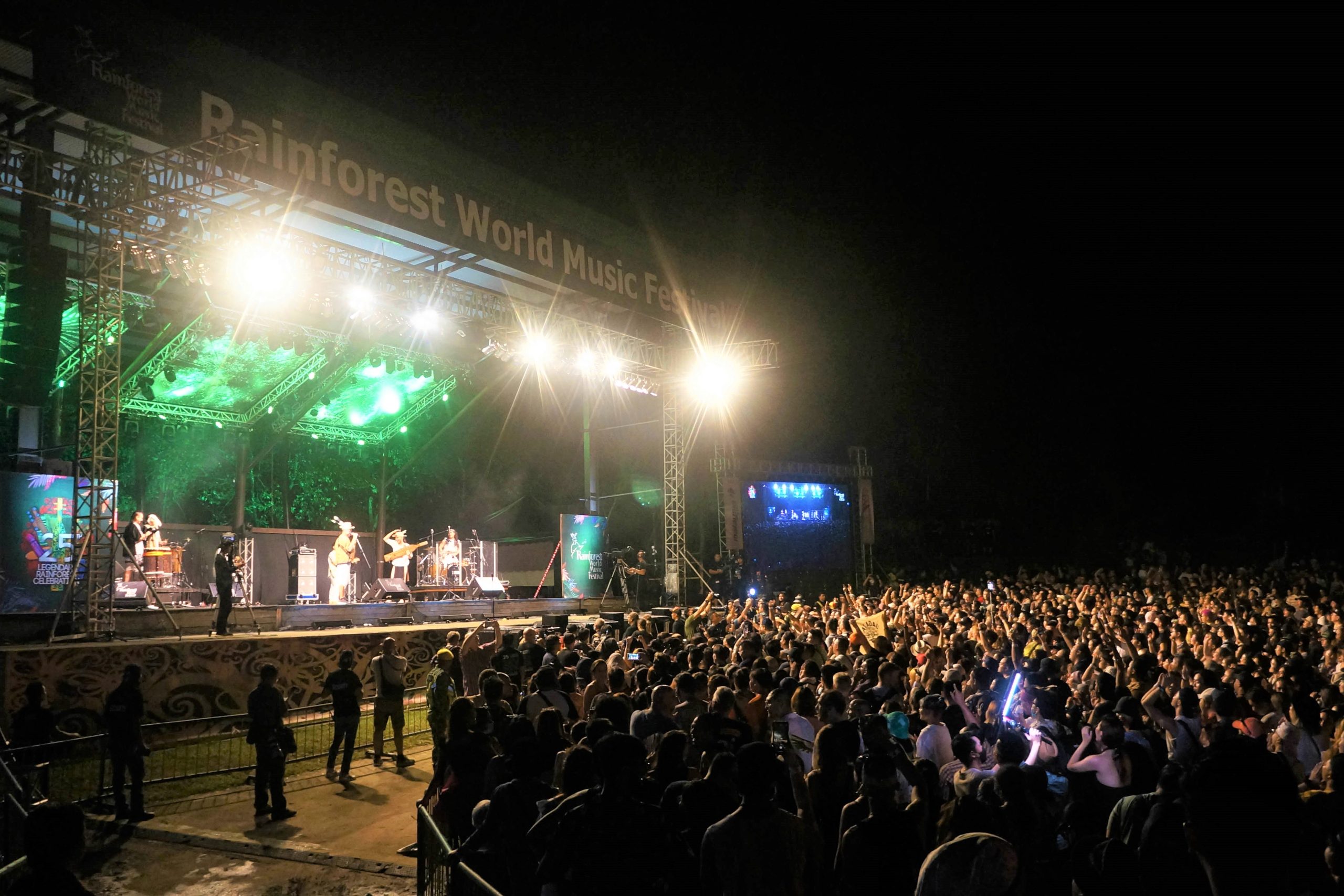
A two year hiatus did not stop the momentum of the legendary Rainforest World Music Festival (RWMF) in Sarawak, Borneo, Malaysia. Having grown from an audience of 300 in 1998 (the festival’s inception) to a record-breaking audience of 22,000 in 2017, it is fair to say that the magic still holds.
This year is the first ever hybrid festival covering live performers from Indonesia, Australia, India, South Korea, Singapore, China and Malaysia. Performers from America, Latvia, China, Canada, Italy, The Philippines, Vietnam, Italy, Japan, Madagascar, Thailand, Iran, India, Poland, Finland and Benin who were unable to perform live this year, lightened up the digital stage to an even more diverse and integrated event!
There were over 6000 audience for Day 2 of the Festival. This 3 day event offers not only renowned international musicians to indigenous Dayak performers of Borneo, but from delectable food bazaar to vibrant craft workshops and from jamming sessions to interactive music workshops. There’s everything from traditional music to world fusion to contemporary world music all wrapped up in one truly global festival smack in the middle of the jungle of Borneo.
One of the biggest attraction during the day was the RWMF Pride of Sarawak Crafts Market by Society Atelier Sarawak. Their booths are located all around the award-winning Sarawak Cultural Village where the festival is held. The venue itself is a living museum where you can “See Sarawak in Half a Day” Highlights of the RWMF Pride of Sarawak Crafts Market included workshops of the best of local and regional makers, ranging from batik painting, pottery making and terrarium crafting, supporting social impact ventures and even body therapies to ease the aches and pains from the vibrant impact of these festivities!


You may find all types of native handwork at Rumah Melanau such as the traditional Bakun Beads, Pua Kumbu weaving and Penan Murum Rattan handcrafts. Besides clothes, rattan baskets and fashionable pua kumbu shawls, you may also discover the luxurious Savo soap made not only of 100% natural ingredients but from the exotic ‘tree butter’ from the Borneon jungle. The fruits from the engkabang tree (shorea macrophylla) is called illipe nuts, used to make lipsticks, moisturizers, soaps and cooking oil – typically known as the Borneo version of cocoa butter. However, the trees flower and fruit irregularly – more than 5 years apart with Jan and Feb as the special months of harvesting. This source of fat, usually mixed with rice, has been widely used in the jungle of Borneo as early as the 1920s.
Apart from luscious and organic home grown produces and stylish handmade accessories to lug home as souvenirs, you also had the privilege to meet and chat with our Sarawak Living Legends of crafts and listen to their stories. Special appearance by Roselyn Lah, an expert in Orang Ulu beads and culture, Michael Lim – batik artist, Ramsay Ong – local artist and Matthew Ngau – Sape master allowed the audiences to come together and enrich themselves with the wisdom of the elders.


For me, I had my very own enriching experience – the hands-on Sape’ workshop. Sape’, the most popular instrument of the RWMF is a traditional lute of the Kenyah and Kayan community in Northern part of Sarawak. Sape’ is carved from a single bole of wood, usually reaching over a metre in length and shaped like a boat. Organized by the Persatuan Anak Seni Sape’ Kuching (PUSAK), this is the first ever sape’ playing workshop for both adults and children. During the early day, one had to travel upriver for miles to reach one sape’ player. Now, not only you can find hundreds of them, you are able to cradle and strung one with your own hands! I was handed a two-string sape’ and tried to strung a simple tune called ‘Put Burui’ guided by the organizers – it wasn’t simple at all. We get to laugh at each other’s’ raucous while the organizers patiently corrected our techniques. This, for me was the most memorable experience during the festival.
Nightfall. As the temperature in the jungle decreases, the temperature of the festival rises. The crowd gathered around the Jungle Stage as it came to live. The opening performance was by our local Majlis Seni Sarawak (MSS) or Sarawak Arts Council, which became a statutory body in September 2021. Their high energy performance was the perfect opening for the 25th RWMF 2022.


Other highlights on the live stage on Day 1 was the performance by the celebrated Sape’ Master – Mathew Ngau Jau and Ngajat expert Salomon Gau, Bluguru Australia – a fusion of Indian, Blues, Celtic, Swing, Jazz and Bluegrass music, and the Balawan Indonesia – who developed the 8 Fingers Touch-Taping Style technique and is regarded as one of the fastest guitarist in Indonesia.
The Digital Stage featured Joey Ayala from the Phillippines – a fusion of ethnic instruments with modern pop music, Auli from Latvia – a magnificent fusion of bagpipe and drum music, Ma Guoguo from China – famous for reviving the art of playing the Chinese multi-leaf kouxian or jews harp, and our local Ezra Tekola from Sarawak on the nose flute.
Day 2 featured Fauziah Gambus who is a multi-award-winning professional vocalist and gambus performer, the contemporary local group At Adau which brings the traditional Sape’ back to life by blending it with traditional percussion from different tribes in Sarawak, and the electrifying Dongyang Gozupa from South Korea taking on the yaggeum (Korean hammered dulcimer) and bass while having the award winning Dohyuk Jang on percussion. This group is definitely a force to behold!
The Digital Stage featured Kevin Locke from America playing the Indigenous Northern Plains flute, I Beddi from Italy – the prize-winning folk music group from Sicily, Mélisande from Canada offered an electrifying blend of traditional music, pop and electro, and Shashank Subramanyam from India specializing in Indian Classical Music.
Day 3 Live Stage featured the Flame of the Forest from Singapore, an instrumental world fusion music group, the long awaited Sarawak Sweetheart Alena Murang who is an award-winning artist and the first professional female sape’ player breaking the stigma of sape’ playing for women, Nikita Sarna who is the youngest sape’ player at mere age of 11 played alongside the gorgeous Alena Murang, the unique Arthur Borman and his Pratuokng (Bamboo Tube Zither) instrument, and Malaysia’s very own Bourbon Lassi combining western elements such as blues, funk and jazz with traditional Indian elements such as the tabla and sitar.


The Digital Stage takes on Lai Muang from Thailand with various traditional musical instruments, Kiki from Japan who is a true Japanese Tsugaru Shamise Duo, Warsar Village Band from Poland featuring contemporary Polish folk-rock, and Yoro Noukoussi from Benin who draws you in to the sights, sound, and rhythms of West Africa.
If a hybrid festival can be this good, one can only imagine how extraordinary this event will be if it is fully live! According to a study, 89% of people believe music is essential for their health and wellbeing. To witness the crowd dancing and singing to the live performances was truly a sight to behold. Day 2 was the climax of the event where the high energy performances were held. The crowd was screaming “We want more! We want more!” to At Adau and Dongyang Gozupa. The crowd was fully immersed in the music and the muddy terrain did not stop them from stomping and dancing to the music. It was a rave! A jungle rave! When Alena Murang finally performed on the last day with her mellow sape’ tune and singing in the endangered ‘Kenyah’ and ‘Kelabit’ languages, you can feel how somber the crowd became as she exited the stage. This festival not only bring people to share their music but it also brings people from different cultures to spend the weekend together. But the true greatness lies in the fact that there are no boundaries between the performers and the audiences, where we are free to chat and take pictures with those live performers after the event.


This trip, I had the chance to get up close and personal with the wonderful At Adau. Founded in 2014, the name At Adau comes from the combination of two Sarawakian languages. At refers to “roots” in the Bidayuh language while Adau in the Kenyah dialect refers to the legendary wood for Sape’. Legend has it that a Shaman or ‘Pawang’ in Kenyah once had a dream to heal his ailing wife. In his dream, a spirit came to him and told him to cut this Adau tree and make a 2-string lute in the shape of a boat and strung it to his wife. Hence, Sape’ was born. It was originally used as both healing instrument and ritualistic music. With their catch phrase “Music that Heals”, At Adau combines the traditional tunes of sape’ with modern instrument to create innovative and timeless music. Their band members include Meldrick Bob Udos on jembe, Iban drum, percussionist and rum set; Ezra Tekola on 4 and 6-string sape and nose flute; Jackson Lian Ngau on perutong, Bidayuh drum and bass drum, Luke Wrender David on 4 and 3-string sape; Cedric Riseng on guitar; Alfanso Mckenzie and Clement Cyril on bass. Driven and influence by Jerry Kamit who is the father of contemporary sape’ and Lan E Tuyang, and ensemble lead by the living National Heritage, Mathew Ngau Jau who is also Jackson Lian’s father, At Adau rose and became a big cult figure in the local Sarawak scene in the last few years.
They were winners of the Waterfront Music Festival 2016, Best Special Talent 2015, Best short movie in 2015 for “Pimonu” and 2017 for “Ajen Oku”. And today, they are growing stronger than ever before. Their outstanding performance during the RWMF 2022 was the hype of the festival. They shook both the stage floor and the audiences to the core. I have not heard a single person who wasn’t moved by their music. And yet, they are learning new instruments, experimenting new concoction of modern music infused with traditional musical instruments.


Ezra Tekola started learning the exquisite nose flute since 2018 and is aspiring to learn the ‘Lutong’, a rare instrument from Belaga, Sarawak which is supposedly a ‘sape’ for women’. Jackson Lian Ngau is a sensation of his own. Well known for his contemporary ‘Ngajat’ or indigenous dance of the Iban tribe performed by warriors on their return from battles where the male dancers usually wear large feathers as part of their headgear, hold on an ornate and long shield in their hand with chains, beads and loincloth called the ‘cawat’. Jackson, added an interesting twist to this traditional dance. He stripped himself off those shields and swords and wore only ‘himself’. “In the modern days we have to free ourselves. The war we are currently fighting now is not the kind of war consisting of weapons but our own hearts. We have to brace ourselves and our hearts to survive,” he said.
10 MOST SPECTACULAR HIKING TRAILS IN SELANGOR
Sarawakians have a profound love for their traditions. They do not want their beautiful tradition to die out and want it to be appreciated. At Adau paired the traditional elements with modern instruments and genres to encourage younger generations not to forget about their roots and their traditions. They hope in the future that they can promote the beautiful Borneo traditional instruments, music and art to the world and to continue the legacy of the craftsmanship of the legendary lute Sape’.
Photos by Paun Cher Chin