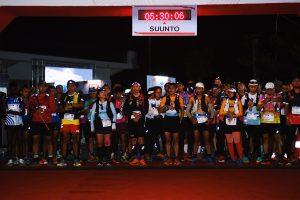
What is this strange force that draws us upwards, this siren-song of the summit? Along the angled slopes of the highest and holiest mountain of Japan, Mount Fuji whispers to us.
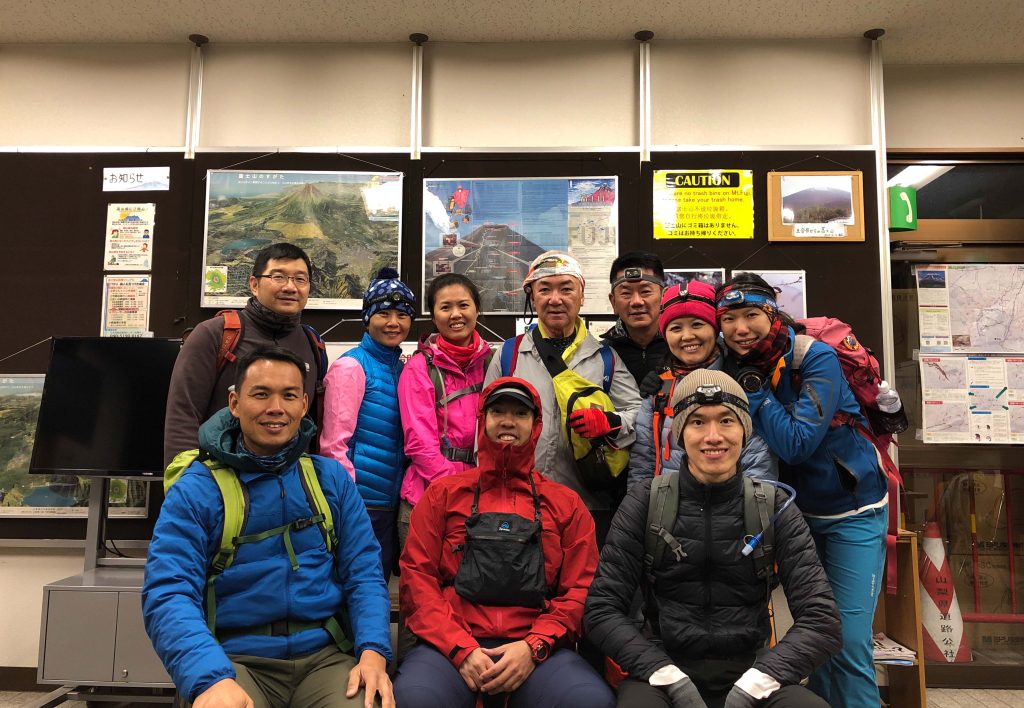
Coincidentally, it is also the beginning of Tsukimi (月見), a festival honouring the moon of Mid-Autumn. The lunar force in the form of moonlight so radiant and graceful rendering our headlamps inept during this solemn midnight ascend. The perk for climbing off-season is that we do not need to experience the much-dreaded climbing-jam of Mount Fuji (averaging 5000 hikers per day!), while the downside being sacrificing our sleep for the night as the mountain huts are closed. We start our journey from Station 5 on Yoshida Trail. Although dark, as we ascend higher, we see the vibrant city lights of Yamanashi, blinking continuously like millions of stars through the night.


We inch our way up the winding and basaltic terrain of this holy mountain, while being vigilant for falling rocks! There are 10 Stations of Fuji with Station 10 being the summit and we are aiming to reach the summit by sunrise or goraiko. But with every step; our breath gets shallower, our pace saunter. Hiking through the night is no mere feat…even for seasoned hikers. At Station 8, four hours later, we decided to eat and rest by the hut. I could hardy stay awake by then, so I took a shorter break and decided to focus on the ascend. I climb the ever zig-zagging trail of Fuji which seems to get steeper or is it my own delusion. I see hikers along some corners wrapped in emergency blankets getting shut-eyes and wondered if they are dead. The temperature is zero degrees to sub-zero and in the light of pre-dawn, I finally see it; the great tori gate of Mount Fuji. ‘Oh glorious peak just within our reach!’ I ponder, but devastatingly, an hour later it was still ‘within reach’. I realise that I had totally disregard the significant effect of altitude on our vitality. I pass the grand tori gate and struggle to remove my glove to take a picture before moving towards a plateau to welcome the goraiko. I see rows of wooden benches with fellow climbers chatting away excitedly and taking photos and I finally resigned and rested on one empty bench. I close my eyes feeling the warm sunrays on my face, my hands and my body. I open my eyes again to a pale orange illumination among scantily arrayed blue sky emerging from a thick sea of clouds surrounding the sacred mountain. I whisper a silent prayer and thank God for this day.



Being great followers of Tantalos, we then traverse half of the peak’s crater towards an old Weather Station, launched in 1932 which is now unmanned. This point is rumoured to be the highest point of the sacred mountain, standing at roughly below 3800m asl. Satisfied with our accomplishments, we head back down by way of the descending trail, which turned out to be an extended version of mega rocky zigzagged-trail. Gliding uncontrollably down with irritable eyes from drifting sand and dirt, I peer up the slope to look out for falling rocks with great effort. Falling rocks has recently reported to be the cause of demise of several hikers. After a knee-throbbing and calves-shaking 3 hours descent, we are finally back at the Fifth Station which during the day, looks like a mini town of its own – ice cream parlours, fancy restaurants and even souvenir shops. I can’t believe we climbed 12 hours through the night.
However, our endeavour isn’t over yet. Right after descending Mount Fuji, we need to make haste for our next destination – Ashiyasu, the gateway to Mt Kitadake (北岳)and second highest peak of Japan. Forsaking sleep and slumber for a deeper ecstasy – to conquer both highest and second highest peak of Japan, and to venerate the great Mt Fuji from another mountain! Nonetheless, the ever-erratic mountain weather may also demolish our spirits asunder. The journey from Mt Fuji to Ashiyasu takes 3 hours by car with most of us battling minor mountain sickness (from the extreme ascent and descent of Mt Fuji) and struggling with narcolepsy. As nausea and split headaches overwhelm our senses, the tough and brave ones soldier on driving and keeping wake. By sunset, we reach the tatami-boarded lodge. We finally rested our worn out bodies on this Southern Alps Lodge’s hot spa (ゆ) before enjoying an exquisite and satisfying Japanese dinner (和食)served also at the lodge. And of course, beer. Kitadake is evidently a famous mountain, as the restaurant was filled with hikers that night. Still early after dinner, body muscles heavy from fatigue and deep-heated hot springs, we fell fast asleep early.

Morning, 4am. With no time to weep over our aching torsos, we prepare ourselves, body and mind for the second highest mountain of Japan, Kitadake. We leave the lodge at 05:30am to Hirogawara (1500m asl) by a special mountain bus. Hirogawara is the trail-hub of the Southern Alps or in other words, an information centre for numerous trail heads. Realising we are ahead of time, we decide to have breakfast before starting our trek to Katanokoya hut (3000m asl) where we will stay for the night. The trail today is gradual and relatively easier as we hike through rich mossy birch forests and meadows, but our very much anticipated Mt Fuji is nowhere in sight. Several breaks and several hours later, taking our time while praying for Mt Fuji to reveal itself to us, we finally reach Katanokoya Hut around 3pm. At Katanokoya hut, gloomy clouds start looming in and the silhouette of Mt Fuji emerge and disappear as undecisive as the rain clouds itself. We decided to wait outside, cold and miserable until sunset, before seeking the warm refuge of the mountain hut. After dinner, we tried to sleep early to gain our strength for tomorrow’s trail and also prayed for a clear view tomorrow.

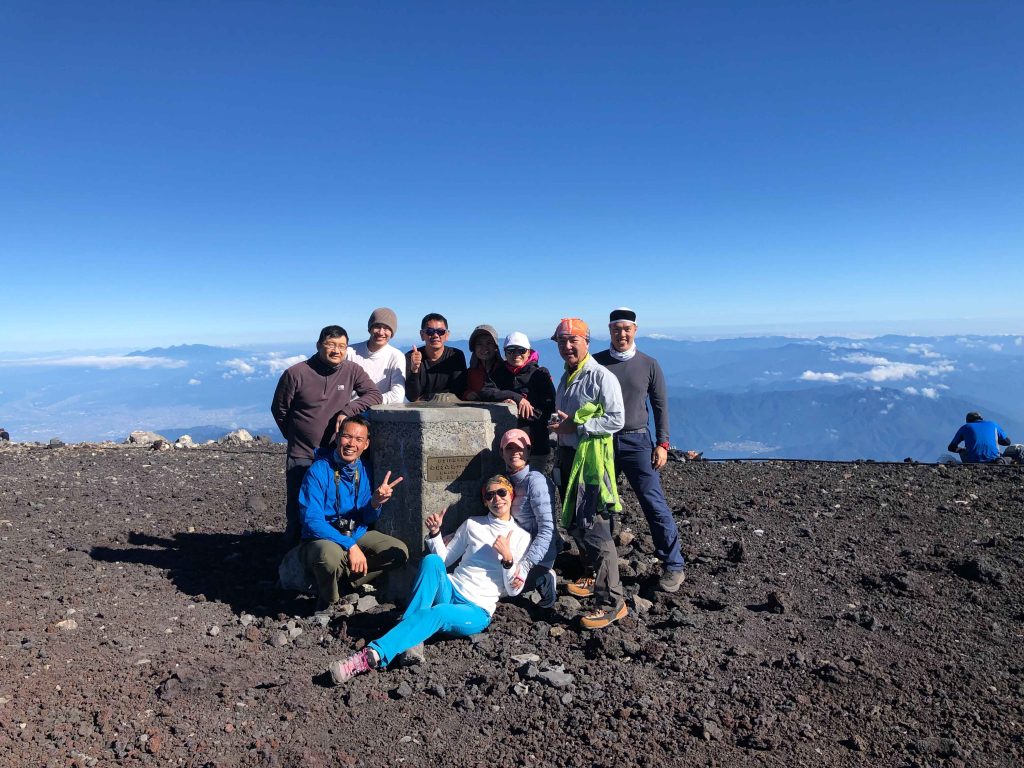
It is pre-dawn again. This time we head east-ward through rocky slopes and boulders towards the peak of Kitadake (3193m asl) That’s when we see it – from the highest point of the second highest mountain of Japan – the conical shaped Mt Fuji! Blue and white from a distance, our prayers were answered. Oh how glorious it is – today will be a great day indeed. Triumphant, we took pictures with silly poses for hours at the plateau of a peak. This time, the great Mt Fuji didn’t shy away from us, it stood proud and clear atop a sea of white clouds with a clear blue-skied backdrop. The morning sun was bright and scorching but none of us were complaining. Satisfied, we headed back to Hirogawara via Happonba, a rocky ridge followed by Okanbasawa, a gorge and glacier path. We admired the beauty of Mt Fuji whenever it appeared, throughout our descent.


A different pathway down, our descending journey was far more challenging and treacherous. We descend slowly, always in a group, especially through those steep rocky ridges. After around 3 hours of ridge hike and Mt Fuji finally out of sight, we break for lunch. Here, we reached the crosstrail of Mt Ainodake (third highest peak of Japan) and Mt Kitadake, and another siren-song was heard calling us to the third summit…which we, regrettably didn’t plan for! Alas, we reluctantly headed down back to Hirogawara lodge, while ignoring our inner desires to conquer the third highest mountain of Japan.
Mountain climbing is similar to illicit substances in many ways. We crave for it while being aware of the dangers it can do to our mind and body. We go through extreme measures to obtain it and we spend (willingly) all our money on it. While the effects of recreational drugs may be fleeting, the effects of mountain high can last for days and even weeks for some. Resisting it is futile and the cure for it, unfortunately, is more climbs.