Hikers are adventurous bunch of people. Some hike for the love of nature while others hike to see the world. Whatever the reason it may be, we often times look for the opportunity to hike in a foreign country to expand the horizon of our hiking experiences.
When we received the invitation from Turkish Airlines and Turkey Tourism, we were so excited that we are going to explore a foreign land 11 hours flight time away from home. We were not sure what we would be getting ourselves into when we landed in Turkey. But one thing for sure is that, every step that we take outside of our home is a new learning experience.
Sit back and relax as we are about to begin our journey to the Southeastern side of Turkey.

Sits at the crossroad between Asia and Europe, Turkey bridges Western Asia with Eastern Europe. Due to its geographical location, Turkey is rich with breathtaking natural beauty, unique history and archaeological sites. Neighboring Azerbaijan and Iran on the east, Iraq and Syria on the southeast, Georgia and Armenia on the northeast, and Greece and Bulgaria on the northwest, the rectangular-shaped country is also encircled by the Aegean Sea, the Black Sea, the Mediterranean Sea and the Sea of Marmara.

When we landed in Istanbul, we didn’t stop but took another 2 hours flight to the land of pistachios, Gaziantep. Situated on the Southeastern side of Turkey, Gaziantep is the city for naturalists, historians, archaeologists, nature adventurers and enthusiasts of art.
Also known for its gastronomic connections to the ancient past, Gaziantep is listed in UNESCO’s Creative Cities Network. When you are here, Lahmacuns (a delicious pizza topped with spicy meat and herbs), İçli Köfte (a kind of meatball that has been cooked with a paste made of cracked wheat and meat and then fried) and baklava (a honey and nut pastry in Turkey) are the three of many must try delicacies.
Spend at least 2 days here, Gaziantep has a long list of places for you to explore including:
- Zeugma Mosaic Museum (for the world-famous gypsy girl mosaic),

- Gaziantep Castle (built as a watchtower during the Roman times with the Justinian era appearance, the archaeology museum houses important artefacts from Neolithic, Hittite and Roman times),
- Kitchen Castle Müzesi,
- Medusa Glass Museum,
- Gaziantep Mevlevihanesi Museum,

- Copperware Bazaar,

- Historical Elmacı Bazaar, and

- Zincirli Covered Grand Bazaar
Don’t forget to enjoy a cup coffee at the 400-year old coffee shop, Tahmis Kahvesi, too.

A little 3-hour drive further to the east of Gazinatep is the city of Adiyaman. As soon as we checked in our hotel, we are restless as we could not wait to wake up at 4 the next morning to scale Mount Nemrut (Nemrut Dağı National Park) for the gigantic statues.

At the height of 2206m, the colossal statues of Apollo, Zeus, Hercules, Tyche and Antiochus stand tall at the 1st century BC tomb built by King Antiochus I of Commagene. This is an eye opener. How did they bring the 10m statues of gods to the summit?

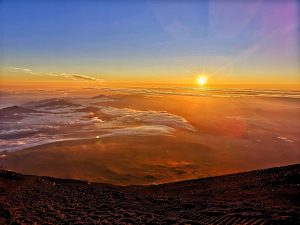
As the sun begins to rise, the spectacular view of Mount Nemrut becomes even more magnificent when the sunray shines on surrounding hills and mountains.
What more can you do in Adiyaman? Here is the list:
- Eskikale (Arsameia of Nymphaios) – a magnificent relief in the ruins of what scholars believe might have been the Commagene Palace depicts Hercules greeting King Antiochus.

- Şeytan Köprüsü
- Old and new Kahta Castle
- Cendere Bridge – the 2nd century Roman bridge still in use today.

- Karakuş – another Commagene royal tumulus where a 9m-high pillar with an eagle on top was built in the 1st century BC.
- Adıyaman Archaeology Museum – where regional finds from the Lower Fırat of the Neolithic and Chalcolithic ages are housed.
When you are done with Adiyaman, drive yourself 150km down south to the ancient city of Urfa, also known as Şanlıurfa. With a history of 12,000 years, many monuments of ancient civilisations, which have remained buried for thousands of years, are being brought to light one by one by archaeological workings throughout the city. Among them are the Neolithic Age settlements in Nevali-Çori in the county of Hilvan, the Chalcolithic Age settlement dating to 5000 BC in Kazane near the city centre and the artefacts dating from 10,000 BC in Biris cemetery in the county of Bozova.
Urfa is known as the “Jerusalem of Anatolia” and regarded as a holy site by Jews, Christians and Muslims alike. According to the Old Testament, the Prophet İbrahim (Abraham), “the father of three monotheistic religions”, was born in the city of Ur and he, together with his family, migrated to Harran, the “home of the patriarchs”.
Don’t leave Şanlıurfa if you have not visited these places:
- Balıklı Göl,

- Şanlıurfa Archaeology Museum,

- Göbekli Tepe,

- Sipahi Bazaar
Another must visit city when you are touring the Southeastern side of Turkey is the city of rocks. Mardin, a 3-hour drive to the East of Şanlıurfa, is known for its golden stone houses elegantly built on the steep slopes. When you walk the staircased streets, small squares and take in the view of the traditional dwellings in the city, the civilization and culture of thousands of years are reflected before your eyes.
We wrapped up our tour to the Southeast side of Turkey with these last 3 places in Mardin before flying home:
- Mardin Castle

- Monastery of Deyrulzafaran – once the ecumenical seat of the Patriarch of the Syriac Orthodox Congregation dating back to 5th century, is the most important religious centre of the Syriac Orthodox Christians. It roofs 3 places of worship from various periods.

- Zinciriye Medrese
If these aren’t enough for you, consider these Top 5 Trekking Routes in Turkey. You will be on your way to the whole new active tourism experience.